what volume of a 100 molar fe(no3)3 solution can be diluted to prepare 1.00l
Chapter 3. Composition of Substances and Solutions
3.3 Molarity
Learning Objectives
By the stop of this department, you will be able to:
- Describe the fundamental properties of solutions
- Calculate solution concentrations using molarity
- Perform dilution calculations using the dilution equation
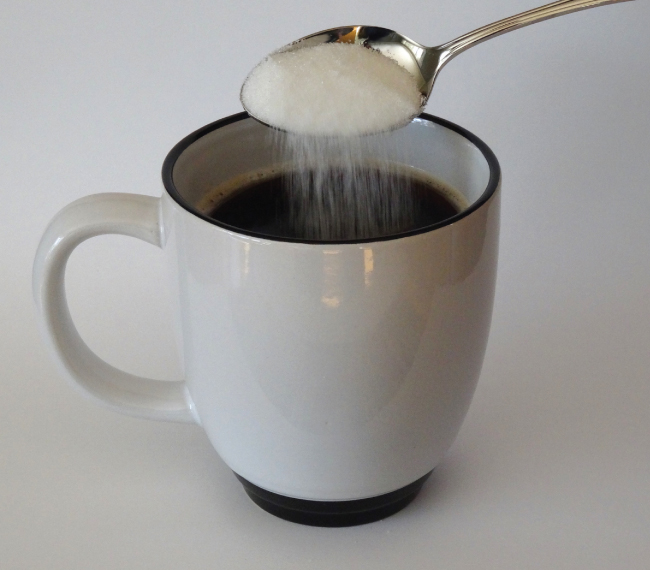
In preceding sections, we focused on the composition of substances: samples of thing that incorporate merely i type of chemical element or chemical compound. Nevertheless, mixtures—samples of thing containing two or more substances physically combined—are more unremarkably encountered in nature than are pure substances. Similar to a pure substance, the relative composition of a mixture plays an important role in determining its properties. The relative corporeality of oxygen in a planet's atmosphere determines its ability to sustain aerobic life. The relative amounts of iron, carbon, nickel, and other elements in steel (a mixture known equally an "alloy") determine its physical force and resistance to corrosion. The relative amount of the active ingredient in a medicine determines its effectiveness in achieving the desired pharmacological effect. The relative amount of sugar in a beverage determines its sweetness (run across Effigy 1). In this section, we will describe one of the most common ways in which the relative compositions of mixtures may be quantified.
Solutions
We have previously defined solutions as homogeneous mixtures, pregnant that the limerick of the mixture (and therefore its backdrop) is uniform throughout its unabridged volume. Solutions occur oftentimes in nature and have as well been implemented in many forms of manmade technology. We will explore a more thorough treatment of solution properties in the chapter on solutions and colloids, but hither we volition introduce some of the basic backdrop of solutions.
The relative amount of a given solution component is known as its concentration. Often, though not always, a solution contains one component with a concentration that is significantly greater than that of all other components. This component is called the solvent and may exist viewed equally the medium in which the other components are dispersed, or dissolved. Solutions in which water is the solvent are, of form, very common on our planet. A solution in which water is the solvent is called an aqueous solution.
A solute is a component of a solution that is typically nowadays at a much lower concentration than the solvent. Solute concentrations are often described with qualitative terms such equally dilute (of relatively low concentration) and concentrated (of relatively high concentration).
Concentrations may be quantitatively assessed using a wide variety of measurement units, each convenient for detail applications. Molarity (G) is a useful concentration unit for many applications in chemistry. Molarity is divers every bit the number of moles of solute in exactly i liter (ane Fifty) of the solution:
[latex]M = \frac{\text{mol solute}}{\text{L solution}}[/latex]
Instance 1
Calculating Molar Concentrations
A 355-mL soft drink sample contains 0.133 mol of sucrose (table carbohydrate). What is the tooth concentration of sucrose in the drink?
Solution
Since the molar corporeality of solute and the volume of solution are both given, the molarity can be calculated using the definition of molarity. Per this definition, the solution volume must be converted from mL to L:
[latex]G = \frac{\text{mol solute}}{\text{L solution}} = \frac{0.133 \;\text{mol}}{355 \;\text{mL} \times \frac{i \;\text{L}}{1000 \;\text{mL}}} = 0.375 \; M[/latex]
Cheque Your Learning
A teaspoon of table carbohydrate contains nigh 0.01 mol sucrose. What is the molarity of sucrose if a teaspoon of sugar has been dissolved in a loving cup of tea with a volume of 200 mL?
Case two
Deriving Moles and Volumes from Molar Concentrations
How much carbohydrate (mol) is contained in a modest sip (~10 mL) of the soft drink from Example i?
Solution
In this case, nosotros tin can rearrange the definition of molarity to isolate the quantity sought, moles of sugar. We and then substitute the value for molarity that nosotros derived in Example i, 0.375 M:
[latex]M = \frac{\text{mol solute}}{\text{Fifty solution}}[/latex]
[latex]\text{mol solute} = K \times \text{L solution}[/latex]
[latex]\text{mol solute} = 0.375 \;\frac{\text{mol carbohydrate}}{\text{L}} \times (10 \;\text{mL} \times \frac{i \text{Fifty}}{one thousand \;\text{mL}}) = 0.004 \;\text{mol sugar}[/latex]
Check Your Learning
What volume (mL) of the sweetened tea described in Example 1 contains the same corporeality of sugar (mol) as 10 mL of the soft drink in this case?
Case 3
Computing Molar Concentrations from the Mass of Solute
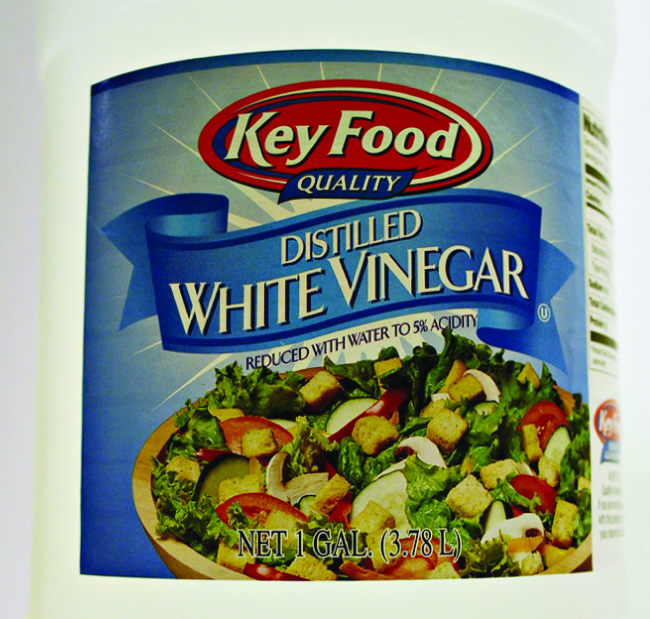
Distilled white vinegar (Figure 2) is a solution of acetic acrid, CH3CO2H, in water. A 0.500-L vinegar solution contains 25.2 chiliad of acerb acid. What is the concentration of the acerb acrid solution in units of molarity?
Solution
As in previous textbox shaded, the definition of molarity is the primary equation used to calculate the quantity sought. In this case, the mass of solute is provided instead of its molar amount, and so we must use the solute's molar mass to obtain the corporeality of solute in moles:
[latex]Thou = \frac{\text{mol solute}}{\text{L solution}} = \frac{25.2 \;\text{g CH}_3\text{CO}_2\text{H} \times \frac{1 \;\text{mol CH}_2\text{CO}_2\text{H}}{60.052 \;\text{chiliad CH}_2\text{CO}_2\text{H}}}{0.500 \;\text{L solution}} = 0.839 \;M[/latex]
[latex]\begin{assortment}{r @{{}={}} l} M & \frac{\text{mol solute}}{\text{L solution}} = 0.839\;K \\[1em] One thousand & \frac{0.839 \;\text{mol solute}}{i.00 \;\text{L solution}} \end{array}[/latex]
Check Your Learning
Summate the molarity of six.52 g of CoCl2 (128.9 g/mol) dissolved in an aqueous solution with a total book of 75.0 mL.
Example four
Determining the Mass of Solute in a Given Volume of Solution
How many grams of NaCl are independent in 0.250 L of a 5.30-Chiliad solution?
Solution
The volume and molarity of the solution are specified, so the amount (mol) of solute is easily computed as demonstrated in Case 2:
[latex]M = \;\frac{\text{mol solute}}{\text{L solution}}[/latex]
[latex]\text{mol solute} = M \times \text{L solution}[/latex]
[latex]\text{mol solute} = 5.30 \;\frac{\text{mol NaCl}}{\text{L}} \times 0.250 \;\text{50} = i.325 \;\text{mol NaCl}[/latex]
Finally, this molar amount is used to derive the mass of NaCl:
[latex]1.325 \;\text{mol NaCl} \times \frac{58.44 \;\text{g NaCl}}{\text{mol NaCl}} = 77.four \;\text{g NaCl}[/latex]
Check Your Learning
How many grams of CaClii (110.98 k/mol) are contained in 250.0 mL of a 0.200-M solution of calcium chloride?
When performing calculations stepwise, as in Instance four, information technology is of import to refrain from rounding any intermediate adding results, which can lead to rounding errors in the terminal result. In Example 4, the molar amount of NaCl computed in the first step, 1.325 mol, would be properly rounded to one.32 mol if it were to be reported; however, although the final digit (v) is not pregnant, it must be retained as a baby-sit digit in the intermediate calculation. If we had not retained this guard digit, the final calculation for the mass of NaCl would have been 77.ane g, a divergence of 0.3 g.
In addition to retaining a baby-sit digit for intermediate calculations, we can also avoid rounding errors past performing computations in a single step (see Example 5). This eliminates intermediate steps so that simply the concluding result is rounded.
Case 5
Determining the Book of Solution Containing a Given Mass of Solute
In Example iii, nosotros plant the typical concentration of vinegar to be 0.839 Thousand. What book of vinegar contains 75.6 g of acetic acid?
Solution
First, use the molar mass to calculate moles of acetic acrid from the given mass:
[latex]\text{one thousand solute} \times \frac{\text{mol solute}}{\text{grand solute}} = \text{mol solute}[/latex]
So, use the molarity of the solution to summate the volume of solution containing this molar amount of solute:
[latex]\text{mol solute} \times \frac{\text{L solution}}{\text{mol solute}} = \text{50 solution}[/latex]
Combining these two steps into 1 yields:
[latex]\text{grand solute} \times \frac{\text{mol solute}}{\text{yard solute}} \times \frac{\text{50 solution}}{\text{mol solute}} = \text{50 solution}[/latex][latex]75.6 \;\text{g CH}_3\text{CO}_2\text{H} (\frac{\text{mol CH}_3\text{CO}_2\text{H}}{60.05 \;\text{g}}) (\frac{\text{Fifty solution}}{0.839 \;\text{mol CH}_3\text{CO}_2\text{H}}) = 1.fifty \;\text{L solution}[/latex]
Check Your Learning
What book of a 1.50-1000 KBr solution contains 66.0 chiliad KBr?
Dilution of Solutions
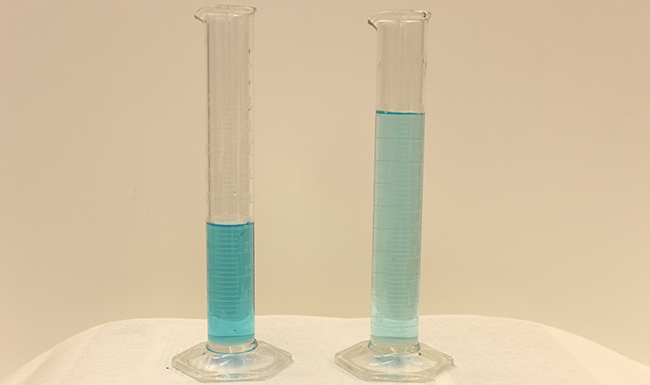
Dilution is the process whereby the concentration of a solution is lessened by the addition of solvent. For case, we might say that a glass of iced tea becomes increasingly diluted as the ice melts. The water from the melting ice increases the volume of the solvent (water) and the overall volume of the solution (iced tea), thereby reducing the relative concentrations of the solutes that give the beverage its taste (Effigy 3).
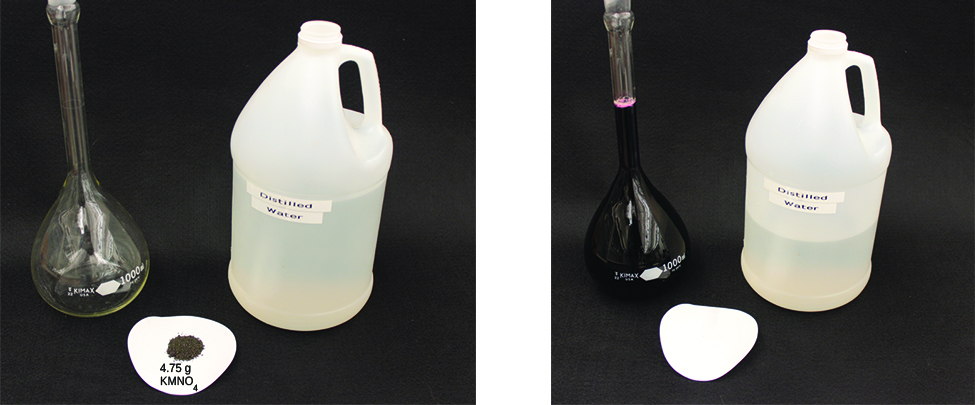
Dilution is likewise a mutual means of preparing solutions of a desired concentration. By adding solvent to a measured portion of a more full-bodied stock solution, we can achieve a particular concentration. For example, commercial pesticides are typically sold every bit solutions in which the active ingredients are far more concentrated than is appropriate for their awarding. Before they can be used on crops, the pesticides must be diluted. This is too a very mutual practice for the preparation of a number of common laboratory reagents (Effigy 4).
A uncomplicated mathematical human relationship can be used to relate the volumes and concentrations of a solution before and after the dilution process. According to the definition of molarity, the molar amount of solute in a solution is equal to the product of the solution'due south molarity and its volume in liters:
[latex]n = ML[/latex]
Expressions like these may be written for a solution earlier and afterwards it is diluted:
[latex]n_1 = M_1L_1[/latex]
[latex]n_2 = M_2L_2[/latex]
where the subscripts "ane" and "2" refer to the solution before and after the dilution, respectively. Since the dilution process does non change the amount of solute in the solution, northward one = northward 2. Thus, these ii equations may exist set equal to ane another:
[latex]M_1L_1 = M_2L_2[/latex]
This relation is normally referred to as the dilution equation. Although nosotros derived this equation using molarity equally the unit of concentration and liters as the unit of volume, other units of concentration and volume may be used, so long equally the units properly abolish per the gene-label method. Reflecting this versatility, the dilution equation is often written in the more general form:
[latex]C_1V_1 = C_2V_2[/latex]
where C and Five are concentration and book, respectively.

Employ the simulation to explore the relations betwixt solute corporeality, solution volume, and concentration and to ostend the dilution equation.
Case half-dozen
Determining the Concentration of a Diluted Solution
If 0.850 L of a 5.00-M solution of copper nitrate, Cu(NO3)2, is diluted to a volume of 1.eighty L by the addition of water, what is the molarity of the diluted solution?
Solution
We are given the volume and concentration of a stock solution, 5 1 and C ane, and the volume of the resultant diluted solution, 5 two. We demand to find the concentration of the diluted solution, C 2. We thus rearrange the dilution equation in gild to isolate C 2:
[latex]C_1V_1 = C_2V_2[/latex]
[latex]C_2 = \frac{C_1V_1}{V_2}[/latex]
Since the stock solution is being diluted past more than two-fold (volume is increased from 0.85 Fifty to 1.80 L), we would expect the diluted solution'south concentration to be less than i-half five M. We will compare this ballpark approximate to the calculated result to cheque for whatsoever gross errors in computation (for example, such as an improper substitution of the given quantities). Substituting the given values for the terms on the right side of this equation yields:
[latex]C_2 = \frac{0.850 \;\text{50} \times 5.00 \frac{\text{mol}}{\text{L}}}{1.80 \;\text{L}} = 2.36 \;M[/latex]
This result compares well to our ballpark estimate (information technology's a bit less than one-half the stock concentration, 5 M).
Check Your Learning
What is the concentration of the solution that results from diluting 25.0 mL of a 2.04-Chiliad solution of CHthreeOH to 500.0 mL?
Example 7
Volume of a Diluted Solution
What volume of 0.12 M HBr can be prepared from 11 mL (0.011 L) of 0.45 Thou HBr?
Solution
We are given the volume and concentration of a stock solution, V 1 and C 1, and the concentration of the resultant diluted solution, C ii. We need to find the volume of the diluted solution, V ii. We thus rearrange the dilution equation in order to isolate V 2:
[latex]C_1V_1 = C_2V_2[/latex]
[latex]V_2 = \frac{C_1V_1}{C_2}[/latex]
Since the diluted concentration (0.12 Yard) is slightly more than than one-fourth the original concentration (0.45 M), we would expect the volume of the diluted solution to be roughly four times the original volume, or around 44 mL. Substituting the given values and solving for the unknown book yields:
[latex]V_2 = \frac{(0.45\;M)(0.011 \;\text{L})}{0.12 \; M}[/latex]
[latex]V_2 = 0.041 \;\text{L}[/latex]
The volume of the 0.12-M solution is 0.041 L (41 mL). The result is reasonable and compares well with our crude estimate.
Cheque Your Learning
A laboratory experiment calls for 0.125 M HNOiii. What volume of 0.125 M HNOthree can be prepared from 0.250 L of i.88 Grand HNO3?
Example viii
Volume of a Concentrated Solution Needed for Dilution
What volume of 1.59 M KOH is required to gear up 5.00 L of 0.100 M KOH?
Solution
Nosotros are given the concentration of a stock solution, C 1, and the volume and concentration of the resultant diluted solution, V 2 and C 2. Nosotros need to find the volume of the stock solution, Five 1. We thus rearrange the dilution equation in order to isolate V 1:
[latex]C_1V_1 = C_2V_2[/latex]
[latex]V_2 = \frac{C_2V_2}{C_2}[/latex]
Since the concentration of the diluted solution 0.100 1000 is roughly 1-sixteenth that of the stock solution (ane.59 M), we would await the volume of the stock solution to exist almost one-sixteenth that of the diluted solution, or effectually 0.3 liters. Substituting the given values and solving for the unknown volume yields:
[latex]V_1 = \frac{(0.100\;G)(5.00 \;\text{Fifty})}{ane.59 \; Grand}[/latex]
[latex]V_1 = 0.314 \;\text{50}[/latex]
Thus, we would need 0.314 L of the 1.59-M solution to prepare the desired solution. This result is consistent with our rough estimate.
Cheque Your Learning
What volume of a 0.575-M solution of glucose, CviH12O6, can be prepared from 50.00 mL of a 3.00-Grand glucose solution?
Primal Concepts and Summary
Solutions are homogeneous mixtures. Many solutions contain one component, called the solvent, in which other components, chosen solutes, are dissolved. An aqueous solution is one for which the solvent is water. The concentration of a solution is a measure of the relative corporeality of solute in a given amount of solution. Concentrations may be measured using various units, with one very useful unit being molarity, defined as the number of moles of solute per liter of solution. The solute concentration of a solution may exist decreased past adding solvent, a process referred to equally dilution. The dilution equation is a elementary relation between concentrations and volumes of a solution earlier and afterwards dilution.
Primal Equations
- [latex]M = \frac{\text{mol solute}}{\text{Fifty solution}}[/latex]
- C 1 V one = C 2 V ii
Chemical science End of Chapter Exercises
- Explain what changes and what stays the same when 1.00 50 of a solution of NaCl is diluted to 1.80 L.
- What information do we demand to summate the molarity of a sulfuric acid solution?
- What does information technology hateful when we say that a 200-mL sample and a 400-mL sample of a solution of salt have the same molarity? In what ways are the 2 samples identical? In what ways are these two samples different?
- Determine the molarity for each of the following solutions:
(a) 0.444 mol of CoCl2 in 0.654 50 of solution
(b) 98.0 yard of phosphoric acid, H3PO4, in ane.00 L of solution
(c) 0.2074 yard of calcium hydroxide, Ca(OH)2, in 40.00 mL of solution
(d) 10.5 kg of Na2And sofour·10HtwoO in xviii.60 Fifty of solution
(due east) 7.0 × 10⁻³ mol of I2 in 100.0 mL of solution
(f) 1.8 × 10⁴ mg of HCl in 0.075 L of solution
- Determine the molarity of each of the post-obit solutions:
(a) ane.457 mol KCl in 1.500 Fifty of solution
(b) 0.515 thousand of H2And thenfour in 1.00 50 of solution
(c) xx.54 g of Al(NO3)3 in 1575 mL of solution
(d) ii.76 kg of CuSOfour·5HiiO in i.45 L of solution
(e) 0.005653 mol of Br2 in 10.00 mL of solution
(f) 0.000889 yard of glycine, C2H5NO2, in 1.05 mL of solution
- Consider this question: What is the mass of the solute in 0.500 50 of 0.thirty M glucose, C6H12O6, used for intravenous injection?
(a) Outline the steps necessary to respond the question.
(b) Reply the question.
- Consider this question: What is the mass of solute in 200.0 L of a 1.556-Chiliad solution of KBr?
(a) Outline the steps necessary to answer the question.
(b) Reply the question.
- Calculate the number of moles and the mass of the solute in each of the following solutions:
(a) 2.00 50 of 18.5 Thousand H2SO4, concentrated sulfuric acid
(b) 100.0 mL of 3.8 × x−five M NaCN, the minimum lethal concentration of sodium cyanide in blood serum
(c) 5.50 L of xiii.3 M H2CO, the formaldehyde used to "fix" tissue samples
(d) 325 mL of 1.viii × 10−six M FeSO4, the minimum concentration of fe sulfate detectable past taste in drinking water
- Calculate the number of moles and the mass of the solute in each of the following solutions:
(a) 325 mL of eight.23 × ten−v Thousand KI, a source of iodine in the nutrition
(b) 75.0 mL of two.2 × 10−5 M H2SOfour, a sample of acrid rain
(c) 0.2500 Fifty of 0.1135 G Yard2CrO4, an belittling reagent used in atomic number 26 assays
(d) x.5 50 of three.716 M (NH4)2SO4, a liquid fertilizer
- Consider this question: What is the molarity of KMnOiv in a solution of 0.0908 g of KMnO4 in 0.500 50 of solution?
(a) Outline the steps necessary to reply the question.
(b) Answer the question.
- Consider this question: What is the molarity of HCl if 35.23 mL of a solution of HCl contain 0.3366 1000 of HCl?
(a) Outline the steps necessary to respond the question.
(b) Respond the question.
- Calculate the molarity of each of the post-obit solutions:
(a) 0.195 g of cholesterol, C27H46O, in 0.100 L of serum, the boilerplate concentration of cholesterol in human serum
(b) 4.25 m of NH3 in 0.500 L of solution, the concentration of NH3 in household ammonia
(c) ane.49 kg of isopropyl booze, C3H7OH, in 2.l Fifty of solution, the concentration of isopropyl alcohol in rubbing alcohol
(d) 0.029 1000 of I2 in 0.100 L of solution, the solubility of I2 in water at 20 °C
- Calculate the molarity of each of the following solutions:
(a) 293 1000 HCl in 666 mL of solution, a full-bodied HCl solution
(b) 2.026 thou FeCliii in 0.1250 L of a solution used equally an unknown in general chemistry laboratories
(c) 0.001 mg Cd2+ in 0.100 L, the maximum permissible concentration of cadmium in drinking h2o
(d) 0.0079 k C7H5SNO3 in one ounce (29.6 mL), the concentration of saccharin in a diet soft beverage.
- There is about ane.0 m of calcium, as Catwo+, in one.0 L of milk. What is the molarity of Ca2+ in milk?
- What volume of a 1.00-M Fe(NO3)three solution tin be diluted to ready ane.00 L of a solution with a concentration of 0.250 M?
- If 0.1718 50 of a 0.3556-G CthreeH7OH solution is diluted to a concentration of 0.1222 Thou, what is the volume of the resulting solution?
- If 4.12 50 of a 0.850 M-H3PO4 solution is be diluted to a book of ten.00 L, what is the concentration of the resulting solution?
- What volume of a 0.33-Chiliad C12H22Oxi solution can be diluted to prepare 25 mL of a solution with a concentration of 0.025 Thousand?
- What is the concentration of the NaCl solution that results when 0.150 L of a 0.556-M solution is allowed to evaporate until the volume is reduced to 0.105 L?
- What is the molarity of the diluted solution when each of the post-obit solutions is diluted to the given final volume?
(a) 1.00 Fifty of a 0.250-Thousand solution of Atomic number 26(NO3)three is diluted to a final volume of 2.00 L
(b) 0.5000 L of a 0.1222-G solution of C3H7OH is diluted to a final volume of 1.250 Fifty
(c) two.35 50 of a 0.350-M solution of HiiiPOiv is diluted to a last volume of 4.00 Fifty
(d) 22.50 mL of a 0.025-Chiliad solution of C12H22O11 is diluted to 100.0 mL
- What is the concluding concentration of the solution produced when 225.five mL of a 0.09988-Chiliad solution of Na2CO3 is allowed to evaporate until the solution volume is reduced to 45.00 mL?
- A 2.00-L bottle of a solution of concentrated HCl was purchased for the full general chemistry laboratory. The solution contained 868.8 g of HCl. What is the molarity of the solution?
- An experiment in a full general chemistry laboratory calls for a ii.00-Yard solution of HCl. How many mL of xi.ix M HCl would be required to make 250 mL of 2.00 Yard HCl?
- What volume of a 0.20-One thousand K2SO4 solution contains 57 1000 of K2SO4?
- The US Environmental Protection Agency (EPA) places limits on the quantities of toxic substances that may exist discharged into the sewer system. Limits have been established for a variety of substances, including hexavalent chromium, which is limited to 0.fifty mg/L. If an manufacture is discharging hexavalent chromium equally potassium dichromate (Thousand2CrtwoOseven), what is the maximum permissible molarity of that substance?
Glossary
- aqueous solution
- solution for which water is the solvent
- concentrated
- qualitative term for a solution containing solute at a relatively high concentration
- concentration
- quantitative measure of the relative amounts of solute and solvent present in a solution
- dilute
- qualitative term for a solution containing solute at a relatively low concentration
- dilution
- process of calculation solvent to a solution in guild to lower the concentration of solutes
- dissolved
- describes the procedure past which solute components are dispersed in a solvent
- molarity (M)
- unit of concentration, defined as the number of moles of solute dissolved in ane liter of solution
- solute
- solution component present in a concentration less than that of the solvent
- solvent
- solution component present in a concentration that is college relative to other components
Solutions
Answers to Chemical science End of Chapter Exercises
2. We need to know the number of moles of sulfuric acid dissolved in the solution and the volume of the solution.
four. (a) 0.679 Thou;
(b) 1.00 Grand;
(c) 0.06998 Thousand;
(d) one.75 M;
(eastward) 0.070 M;
(f) half-dozen.6 M
6. (a) make up one's mind the number of moles of glucose in 0.500 L of solution; determine the molar mass of glucose; determine the mass of glucose from the number of moles and its molar mass; (b) 27 thousand
8. (a) 37.0 mol HtwoSO4;
3.63 × 10iii grand HiiAnd theniv;
(b) 3.eight × 10−half-dozen mol NaCN;
1.9 × 10−four thousand NaCN;
(c) 73.2 mol H2CO;
2.20 kg H2CO;
(d) v.9 × 10−7 mol FeSO4;
viii.9 × 10−5 g FeSO4
10. (a) Determine the tooth mass of KMnO4; determine the number of moles of KMnOfour in the solution; from the number of moles and the book of solution, make up one's mind the molarity; (b) ane.xv × 10−3 M
12. (a) 5.04 × 10⁻³ 1000;
(b) 0.499 M;
(c) ix.92 M;
(d) ane.1 × ten−3 M
14. 0.025 Yard
16. 0.5000 50
xviii. i.nine mL
twenty. (a) 0.125 Thousand;
(b) 0.04888 K;
(c) 0.206 M;
(east) 0.0056 M
22. 11.9 M
24. 1.6 L
Source: https://opentextbc.ca/chemistry/chapter/3-3-molarity/
0 Response to "what volume of a 100 molar fe(no3)3 solution can be diluted to prepare 1.00l"
Enregistrer un commentaire